Sports
What we learned walking the halls at SEC and Big T...
Heather Dinich · May 29, 2026
Source: www.espn.com - NCF · Read on source site
PALOS VERDES, Calif., and DESTIN, Fla. -- Washington coach Jedd Fisch said he would like to see the Big Ten play a nine-game league schedule plus a nonconference game against one team each from the SEC, the ACC and the Big 12.
>"You take your 12 games, see how you've done, you get seeded in the playoff, and then nobody can make these ridiculous arguments about how you do in specific conferences when clearly the conferences are different," he told ESPN. "If the Big Ten goes 11-3 in the games against the ACC or whatever the number would be, then you could make the clear-cut argument, 'Hey, we're going to take an extra Big Ten team,' or whatever it might be."
>"I've been giving this a lot of thought," he said.
>There has been no shortage of ideas and conversations around the future of the College Football Playoff in the past few weeks as each of the Power 4 conferences held its annual spring meeting, but a consensus is still missing among the two with the power to change it. The Big Ten, which has been a proponent of a 24-team model, left the posh Terranea Resort in Southern California firmly entrenched in its belief that doubling the current 12-team field should be the next step.
>One week later, the SEC left its luxury beachside location in Florida still divided over which path to choose, with some publicly backing the Big Ten's 24-team model while others voiced concerns about the financial and competitive ramifications it could have.
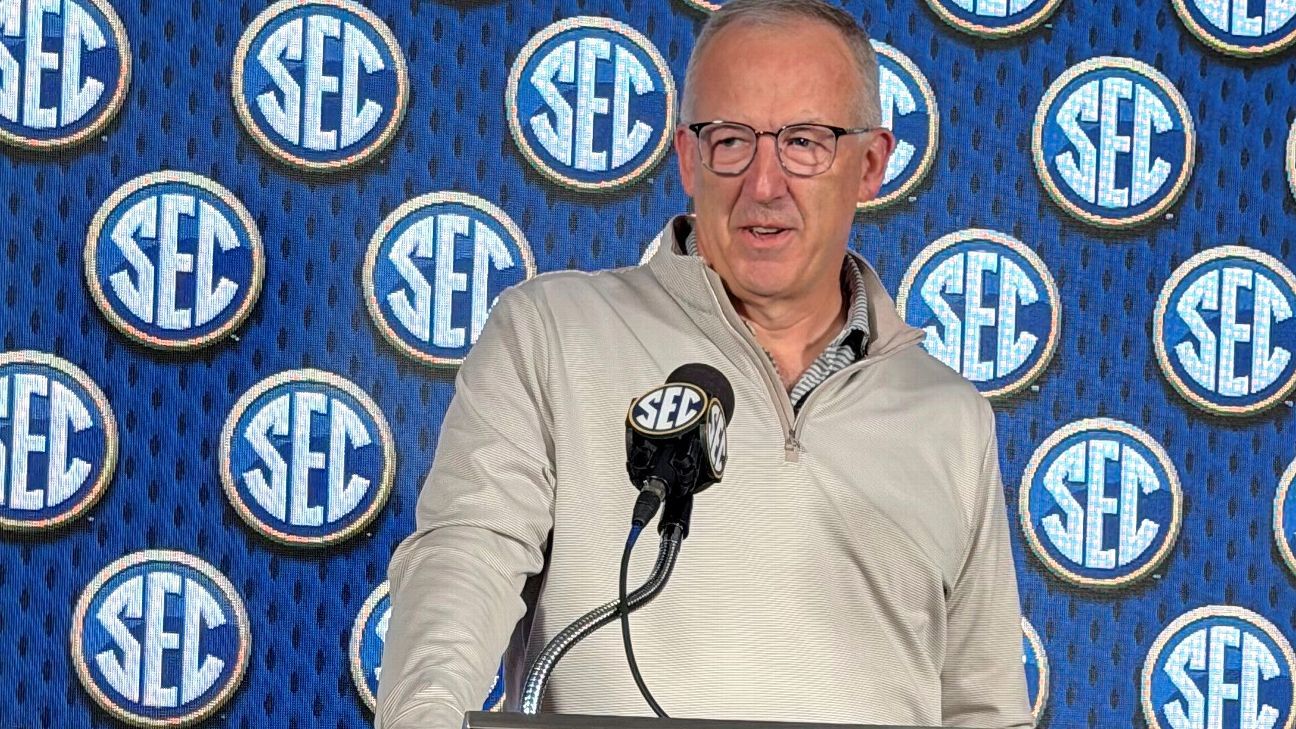
>In order for the format to change by the 2027 season, Big Ten commissioner Tony Petitti and SEC commissioner Greg Sankey have to agree to it by Dec. 1. If only it were as simple as picking the number.
>Here's what athletic directors, coaches and commissioners from the Power 2 had to say this month on the most pressing topics related to the future of the CFP.
>Jump to:
16- or 24-team CFP
TV partners | SEC 'break away'
Conference title games
Regular-season value | Selection committee
>It's 24 teams or bust in the Big Ten after Petitti told reporters his league "had zero conversations about 16" lately. The league's position is a hard no on 16, Petitti said, and the coaches and athletic directors unanimously presented a united front in support of 24.
>"I think 24 is the right number," Michigan athletic director Warde Manuel said. "I just think it's good for college football, having been on the CFP committee, to give a longer runway. It actually helps in the nonconference. You could play tougher opponents like we're playing Oklahoma. ... It allows those games to happen without fear you're going to lose something and then be out of playoff contention if you lose one more game. I think it adds a lot of value to the entire season, a lot of value to the nonconference and a lot of value to the playoff, and it gives more teams more opportunity."
>The SEC presidents and chancellors continue to prefer 16 -- that was the league's official stance coming out of Florida -- but Sankey said he hasn't ruled out 24 and expects a formal decision to be made this fall. Everyone in the SEC expressed interest in learning more about the options, as nobody (including the Big Ten) has seen any data yet to know the media value of additional games. There are also questions about how the CFP would squeeze in eight first-round games, which would require at least two playoff games to compete against each other and possibly even the NFL in the same time slot. It's also unclear how the CFP would handle the Army-Navy game in a 24-team playoff, a conundrum that presents leaders with a puzzle: How to protect the stand-alone time slot while accounting for the possibility one or both of those academies could be good enough to qualify for the field.
>"We've had so much change in such a short amount of time, that I do think we need a little bit of time to evaluate," Texas athletic director Chris Del Conte said. "It's not just, 'Hey, let's jump to this.' I prefer where we're at right now to see what that looks like."
>With the ACC, Big 12, Big Ten and even Notre Dame now leaning toward a 24-team field, Sankey said he's not concerned about being labeled as the lone league standing firm at 16.
>"It doesn't bother me," he said. "... Whether I am or not, I am what I am."
>Tennessee athletic director Danny White was one of the few SEC leaders who publicly supported the Big Ten's 24-team field, but multiple coaches used the phrase "self-preservation" when talking about the increased job security a larger field would provide.
>Is a compromise looming ahead of a June CFP meeting in Denver?
>"We're not buying a car, and the dealer says it's 24 and we say 12, well let's settle at 16," Nebraska athletic director Troy Dannen said. "I don't think you can look at it that way."
>As the CFP enters the first season of a new six-year deal, ESPN remains the sole rights holder to the playoff as long as the format is 12 or 14 teams, which is what the contract currently includes. If the CFP expands beyond 14 teams, ESPN has an exclusive first negotiation right to acquire the additional games. It doesn't just automatically become an open market. The CFP would open that negotiation, not ESPN. When the playoff expanded to 12 teams, ESPN was the only network that bid on the games.
>Big Ten commissioner Tony Petitti said his preference for a media partner in a 24-team CFP is "whoever's committed to making it work."
>"I don't have any real feel about who's the best to program it," Petitti said. "[ESPN] has a deep commitment to college football every week. They're not our partner during the regular season, but we do have games that cross over on ESPN, and those games typically do very well, just like the ones we have on Fox and [CBS/NBC]. I don't go in with any preconceived idea, and no one league is driving that part of the process. That's a collaborative piece that will be done by consultants and whoever else we use, not me."
>Sankey said he's "agnostic" about media platforms, and nobody from a TV network has picked up the phone and told him "we want this or that." ESPN executives have attended Big 12, ACC and SEC conference spring meetings, though, and ACC commissioner Jim Phillips publicly stated the network would prefer a 16-team model.
>"The media company should speak for themselves on their position," Sankey said. "I do think it's important to understand the media marketplace at this time, and that's part of the information that we would be interested in learning before we go into any decision-making process, so whether that equates to influence or not, that's just a description of roles."
>Georgia coach Kirby Smart stood at the podium Wednesday, faced a room full of reporters and boldly said, "I'm not afraid to break away" if everyone in college athletics can't agree to follow the same rules and playoff format.
>His comments echoed those of his university president, Jere Morehead, who told On3 last week that if federal legislation isn't enacted to curtail what he has called "anarchy" in the sport, he's prepared to "be ready to vote on creating an SEC mechanism and SEC rules."
>The idea of the SEC creating its own set of rules is not new. Mississippi State president Mark Keenum told ESPN in early March that SEC presidents and chancellors were meeting in Nashville with the hopes of starting to establish rules and guidance for the league and other conferences -- assuming Congress could not quickly establish federal legislation on NIL.
>While the SEC spring meetings were underway, Senate Commerce Committee Chairman Ted Cruz, R-Tex., and ranking member Maria Cantwell, D-Wash., introduced bipartisan legislation intended to "restore stability to college sports," titled the Protect College Sports Act of 2026.
>There is skepticism amongst some leaders in the SEC that the legislation will have enough Democratic support to be voted into law, which is the driving force behind conversations about the SEC trying to govern itself. This creates its own set of questions.
>"I like the construct of college sports to look and feel the same from a student-athlete standpoint, a fan standpoint," Tennessee's White said. "I think it's really hard to, in a competitive space, to have rules in one conference that don't apply to your competition in other conferences. I can't wrap my head around how that would actually work."
>Sankey pointed out that the SEC has been creating its own rules for decades.
>"Is there a part of dealing with the frustration that's expressed that relates to how we make decisions and how we govern ourselves?" he said. "Yes, but that's not outside the norm."
>What is outside the norm is the SEC making any rules that would impact how the House Settlement is implemented along with working with the College Sports Commission -- something Georgia athletic director Josh Brooks said should be the first step.
>"How do we work around implementing that in a way that's fair, because I've got frustrations that I'm seeing outside of the SEC that institutions I feel are not adhering to any form [of the rules]," he said. "We can debate how the CSC is implemented and the intricacies of a deal being approved or not approved. That's fine. That's like me and you arguing over filing taxes. I have a much bigger problem with those who aren't even filing taxes. Let's stop that first. And if we can't even get to that base level, I would rather coalesce in our own conference and govern 16 on that issue alone. Not saying that's a full breakaway, but what's the first step of that?"
>Keenum told ESPN the presidents and chancellors were presented with several options for future governance, including collective bargaining with the players, but they didn't vote on anything and asked Sankey to come back with additional information by midsummer. Keenum said there's a sense of urgency to make a decision by the end of the summer.
>"We're all recognizing we've got to make some decisions," Keenum said. "We can't just keep kicking this can down the road. We just don't have all the information we need to say we're going in this direction or that direction. We really don't have a definitive pathway."
>Keenum said collective bargaining is possible but "not a highly likely outcome." There are questions about what it would look like and entail. There are also questions about what's legally possible to talk to other conferences about without colluding. Legal counsel has been in every meeting.
>There is a very real acknowledgement, though, that if federal legislation doesn't happen, and no other conference agrees with the SEC's path forward, "we may be out there by ourselves," Keenum said.
>Sources said the SEC title game brings in $80-100 million in total revenue -- a windfall Smart said he is afraid to lose.
>"I don't think it's great for the transfer portal to be ending the season that late, and if that championship game is in the way of that, or gets put on the back burner because of that, I think you'd have to accept it," Smart said. "But I'm really more worried about the financial burden that we're under right now of paying for all of the athletic department. And when you take that revenue stream [from the SEC championship game] out, can we make it work, and that is it sustainable to do without it would be my biggest concern."
>Big Ten commissioner Tony Petitti said he could eliminate his league's conference title game fast enough to start a 24-team playoff in 2027, and multiple athletic directors in both conferences agreed it's a necessary step moving forward.
>"The championship game should not hold this up," Penn State athletic director Pat Kraft said. "It should not hold progress up."
>Tennessee's White said he trusts Power 4 leadership could find a way to compensate for the SEC's lost revenue.
>"I've always been a proponent, and I do this on our campus, build the product right, and the revenue comes next," he said. "So I've got full faith in our commissioner and three other commissioners that are all involved in that conversation."
>Michigan's Manuel said Petitti is looking at models to come up with a different way of declaring a conference champion. Maryland athletic director Jim Smith, whose background includes more than three decades in professional and collegiate sports, said "the math matters."
>The value of losing a conference championship game "has to get reconciled," said Smith, who was the senior vice president of business strategy for the Atlanta Braves before he was hired by Maryland in 2025. "I believe the value in the additional TV games in the playoffs will more than make up what will be lost in all the championship games. The market is going to dictate whether that's true or not, but there is a real belief that that would cover any shortfall from a conference championship game."
>Smart was asked if a 24-team field could devalue the regular season, and he didn't hesitate.
>"Absolutely it can," he said, "but I'm going to go back to self-preservation, because if you ask enough people, they want an opportunity to be in the party. If they don't make the party, they get fired. So then they're worried about the party, not the dilution of the market. So there's competing interests here that I think are unfortunate."
>There are six new head coaches in the SEC, and that's because five schools -- Florida, Auburn, Kentucky, Arkansas and LSU -- fired their head coaches (Ole Miss hired Pete Golding after Lane Kiffin left for LSU). Part of the Big Ten's reasoning behind the larger field was to address the unprecedented coaching carousel that took place last year when Penn State's James Franklin and LSU's Brian Kelly were fired seemingly for an inability to play for the national title.
>Texas A&M; coach Mike Elko echoed Smart's sentiments, joking that he wanted "40, because then I'll make it and then I won't get fired."
>But his boss, athletic director Trev Alberts, said they've got to be careful about protecting the regular season.
>"I do think college football is a little bit different," Alberts said. "I think the regular season really has to matter. I think it should be hard to get in the playoff. ... I think you have to truly understand access is important. What's good for the enterprise? What are the value of those games? What's the impact on the regular season? There's been a lot of really good ideas thrown out there. I just have never seen all the data that supports some of these decisions, and what is the natural outcome of some of these possibilities."
>Oklahoma coach Brent Venables said an expanded playoff wouldn't devalue the regular season because of the incentivized tiers. Teams seeded No. 1-8 would earn a bye and a home game. The top two teams earn "the best path all the way through." And the bottom teams are constantly trying to stay in the field.
>"You still are playing for seeding," Venables said. "So I still think you're earning staying power and leverage once you get into the playoffs, too. So to me the regular season's always mattered, always will, and those games are critical."
>If two teams are facing each other in late November, though, and both teams have already locked up playoff spots, some have wondered if coaches will rest their starters in what have always been impactful games. Venables said "that's not my style," but "if we ever get in that position, we'll find out."
>Maryland's Jim Smith said he went through a similar scenario when he was with the Atlanta Falcons (2004-16).
>"I came from an NFL background where we expanded playoffs during that time, and people were really concerned it was going to water down both playoffs and the regular season, and the exact opposite happened," Smith said. "Every game became more compelling. So, I believe that games will be more compelling at the end of the season, and it will lead to a really interesting playoff. So, I'm very supportive of the 24-team model."
>Washington's Fisch was the quarterbacks coach with the New England Patriots under Bill Belichick, was an assistant with the Rams, and worked for the Jaguars, Seahawks, Broncos, Ravens and Texans.
>"It's not irrelevant in the NFL," Fisch said of the regular season. "Sure, the Rams can afford to lose to the Seahawks in an incredible Thursday night game, but that doesn't mean the game isn't a great game. We're just seeing the way college football was X amount of years ago where the regular season was really a 12-game playoff. Every week you were eliminating yourself or not eliminating yourself if you lost a game versus understanding there's so many things that go into a game and you can lose a game."
>Sankey said that when professional sports have added to their postseasons, "it's always been a small adjustment."
>"You go to 24, and maybe one or two of those games don't matter in the same way," he said. "Rivalry games will matter, I would argue, but if you've got somebody who needs to rest because they're in at 24, those are the things that we want to try to understand. I think you can quantify that."
>Petitti said he doesn't understand the concept of resting players because "you're never safely in one spot."
>"This isn't the Philadelphia Eagles who know the last week of the season whether they win or not, they can't improve their seed or make it worse," he said.
>"I'm just in a very different place from those who feel like it hurts the regular season," Petitti said. "I just have a hard time understanding that."
>Although the playoff format sucked up most of the oxygen in hallway conversations, there was angst behind closed doors about the selection committee's process for choosing playoff teams.
>CFP leaders gave a presentation to the SEC football coaches, and multiple sources indicated that while there was respect in the room, it didn't ease anyone's concerns about how the committee values strength of schedule.
>"In our sport, it's hard to judge one league from the next in terms of their strength of schedule and who you play," Del Conte said, "so it was great for us and our coaches to hear what they look for and what [strength of schedule] was, but you also left it murky as hell, too."
>First-year Oklahoma athletic director Roger Denny said he's hesitant to schedule more tough nonconference games until he trusts the committee will reward it in the selection process.
>"The CFP and that group are working really hard to make sure they can build that trust, but that's got to be part of it," he said.
>Georgia athletic director Josh Brooks said the decision to go to a nine-game SEC schedule needs to "show up immediately" in the committee's metrics.
>"If you're playing nine conference games in what is statistically the hardest conference, then the real debate, it's all going to come down to the 9-3 versus the 10-2," Brooks said. "We all see it coming."
>What they can't see is how difficult it would be for the committee to rank its top 25 in a 24-team playoff, when far more fans would be scrutinizing the bottom of its ranking. Typically, the committee doesn't invest as much time in the bottom of the weekly ranking as it does the top, but multiple sources indicated that's something that will need more diligence in a larger playoff field.
>"It will be a tremendous challenge for the committee chair and members to maintain the level of focus necessary to accurately rank the teams at the back end of the standings," a former selection committee member said. "The similarities among teams in that portion of the rankings are often so close that distinguishing between them becomes exceptionally difficult, creating even greater angst for conferences, coaches, and fan bases alike."
>"Sometimes at the top it's an easier discussion, and so it's quicker," said Manuel, who served on the committee from 2022 to 2024 and chaired the group in 2024. "At the back end, it's a longer discussion because you have more you're dealing with -- who they're playing, how'd they play in the nonconference, you really have to home in on those teams because you might be dealing with two three-loss teams, four-loss teams. What's the data? What did we see on the film? In my three years there, we were always very thorough all the way to the end. Being in the top 25 is really important to a lot of teams. You can't blow it off at the end because it's 24 and 25. You really have to work through it."
>The selection committee has always rewarded strong play "without incentivizing margin of victory," but in recent seasons, there has been a specific number attached to scoring margin that has left coaches wondering if they should score more points.
>Ole Miss coach Pete Golding said one thing that came up while meeting with CFP leaders "that we didn't know" was the 24-point differential the committee uses as a benchmark to help determine a resounding win. Anything more than that doesn't help a team in the eyes of the committee, which is why it emphasizes there's no need to run up the score. But multiple coaches publicly and privately have wondered if they should be coaching differently to impress the committee.
>"That's the difference if you're up 10 late, and you're going to take a knee, really should you take a knee or should you score from the 2-yard line?" Golding said. "That's not what's best for college football, but if that's going to be weighed in the decision, we probably should do that for our players. It's the understanding of when this thing gets close at the end, what are we basing it on? The issue from a coaching standpoint is are the humans in the room qualified to make that decision? ... There's a lot of people who can watch game tape and not know what the hell they're looking at."
>Petitti said the committee's job is "virtually impossible," but the larger field should help alleviate some of the concerns.
>"If we go to 24 with the committee doing it, which is the plan, they're going to have to really grind 16 through 25 or 26 because right now there's no consequences of that," he said. "If a team is 18 or 25, they're going to play in the bowl game the conference directs them to play in. I worry about it, but it requires them to do a lot of work all the way through, but I think because it's big enough, we feel confident that it'll be OK."