Sports
Who's up next in the Big Ten? Oregon? USC? Project...
Bill Connelly · June 21, 2026
Source: www.espn.com - NCF · Read on source site
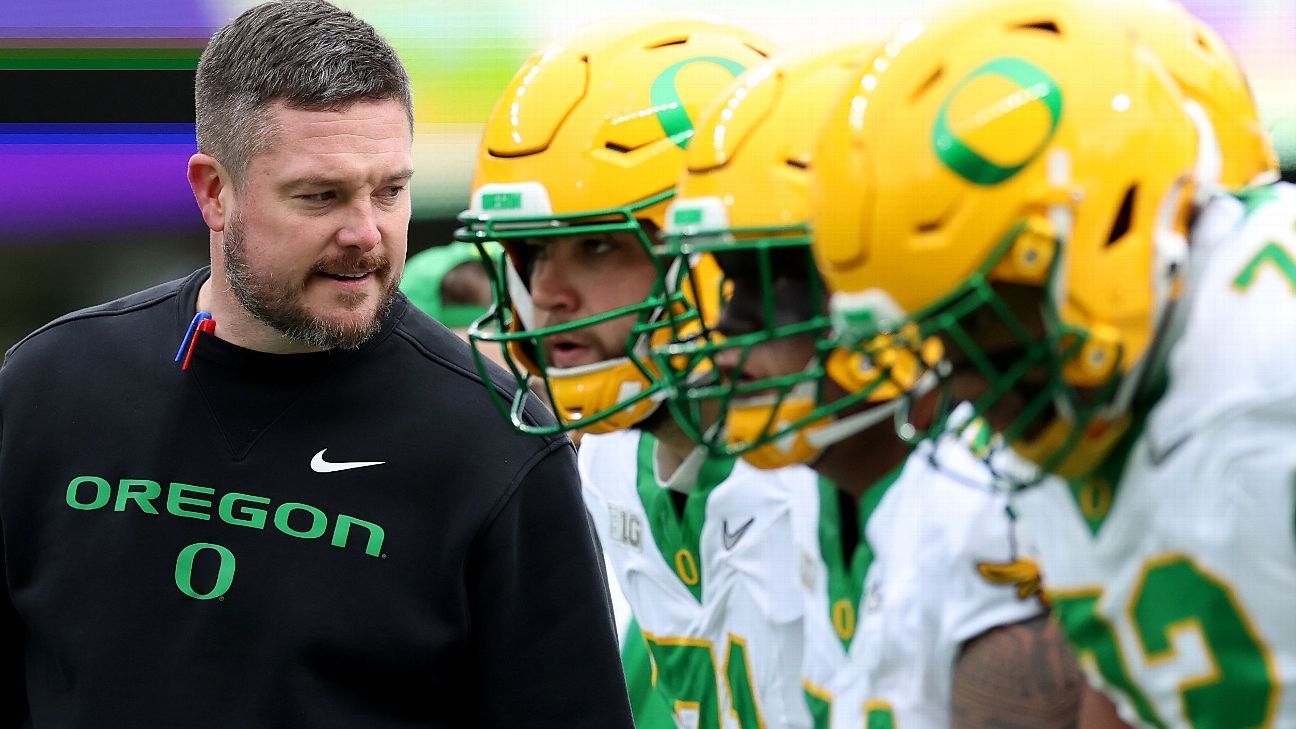
Congratulations in advance to Oregon. If the Big Ten is to continue its recent streak of a different national champion for each season -- Michigan in 2023, Ohio State in 2024, Indiana in 2025 -- Dan Lanning's Ducks are the most likely beneficiary.
>This is certainly a heck of a streak, perpetrated by three different coaches and capping three very different cycles. Michigan's title was the culmination of a nine-year quest and a three-year cycle of increasing brilliance. Ohio State's was the once-per-decade aligning of the stars for college football's consistently elite program. Indiana's was the cap of a two-year bolt from the blue, maybe the most unexpected rise the sport has ever seen.
>Maybe it's indeed Oregon's turn. The Ducks' quest for the promised land has lasted a couple of decades and has been piqued by their three-year unbeaten streak against anyone that didn't eventually reach the national title game. USC also has ramped up its recruiting in its chase for old glory, and virtually everyone else in the conference has to be telling themselves, "Well, if they can do it, why can't we?" in regard to the Hoosiers' surge.
>Maybe 2026 is the year where we circle back to old names. Ohio State is starting the season first nationally in SP+, after all. Or maybe we're just living in Indiana's world now, and the Hoosiers are here to claim all the titles for the foreseeable future. Regardless, the Big Ten figures to be its typical, top-heavy, fascinating self in 2026. Let's preview it.
>Even by the Big Ten's standards, 2025 was a particularly top-heavy season. The conference had three teams better than anyone in the SEC, and seven teams worse than anyone in the SEC. Indiana won it all, and Ohio State and Oregon went 25-1 against non-Hoosier teams. Outside of the top three, Iowa and Penn State (4-9 combined in one-score finishes) were deprived of potentially great seasons by devastatingly close losses -- Penn State fired James Franklin after three of them in a row -- and Michigan, Illinois and Minnesota (combined: 10-1) were propped up by the same thing.
>The continuity table looks at each team's returning production levels (offense, defense and overall), the number of 2025 FBS starts from both returning and incoming players and the approximate number of redshirt freshmen on the roster heading into 2026. (Why "approximate"? Because schools sometimes make it very difficult to ascertain who redshirted and who didn't.) Continuity is an increasingly difficult art in roster management, but some teams pull it off better than others.
>With eight of the top 20 teams in returning production, the Big Ten is certainly Continuity Central, at least relatively speaking. Oregon is in fantastic shape in this regard, with 200 of last year's starts returning, but Ohio State also ranks much higher here than great teams tended to in the pre-portal days. Even Indiana ranking 52nd after winning the national title is high considering how much title teams tend to lose from the NFL draft. I'm curious what it means for a Maryland, Nebraska or Minnesota -- programs with pretty well-established ceilings of late -- to rank as high as they do. How much improvement is possible within the Big Ten's middle class?
>Last year's top five teams are this year's top five teams, though this year's most interesting projection is a few spots down. Penn State is seemingly impossible to project, especially since the Nittany Lions will be more Iowa State than PSU this season under new coach Matt Campbell. They could indeed be a borderline top-15 team or they could stumble out of the top 40 -- neither would surprise me much.
>Penn State's projection becomes even more interesting when you realize how much easier the Nittany Lions' schedule is than the other teams in their general light heavyweight class. The Big Ten has 10 projected top-40 teams, and PSU plays only three of them while Washington plays six and Michigan, USC and Iowa each play five. If we end up with a dark horse team threatening the top three, schedule strength might play a major role.
>Here are the five conference games that feature (a) the highest combined SP+ ratings for both teams and (b) a projected scoring margin under eight points.
>Oct. 10: USC at Penn State. Maybe the first huge conference game of the season is an elimination game of sorts. PSU could announce itself as a dark horse with a win here, and USC, coming off home games against Oregon and Washington, will either be trying to stay in the title race or simply stay afloat.
>Oct. 17: Ohio State at Indiana. For a conference desperately trying to ditch conference title games, the Big Ten sure had a great one last season.
>Oct. 24: Indiana at Michigan. Curt Cignetti's champs survived midseason trips to Iowa and Penn State last season and will face another tricky one here against Kyle Whittingham and his potentially chest-puffing, chip-on-their-shoulder Wolverines.
>Nov. 7: Oregon at Ohio State. Only two Big Ten teams have winning records against Ohio State in this decade: Michigan (4-1) and Oregon (2-1). The Buckeyes -- who lost their last home game to each -- will host both of them within the last four weeks of the regular season.
>Nov. 21: Indiana at Washington. Washington is a bit of a mystery this season, but amid all the customarily huge late-season Big Ten games, this one could be sneaky big.
>QB Josh Hoover, Indiana. I'm just saying, I like Hoover now more than I liked Fernando Mendoza at this time last season. There's almost no way to clear the bar Mendoza ended up setting, but with 9,629 career passing yards and 71 career TDs, Hoover is just about the most battle-tested and proven QB Curt Cignetti could have added to replace his Heisman winner.
>QB Colton Joseph, Wisconsin. As the pilot of one of my favorite offenses in the country last season, Joseph went for 2,264 passing yards, 1,100 non-sack rushing yards and 34 combined touchdowns at Old Dominion. It has been a while since the Badgers had a QB who could genuinely make big things happen, but Joseph will have a chance to become a program savior for Luke Fickell and Wisconsin.
>Leading up to the 2026 season, we're previewing every conference in college football.
Big Ten | Big 12 | ACC | Pac-12 | MWC | American | Sun Belt | Conference USA | MAC
>RB Wayne Knight, UCLA. One of many James Madison transfers to follow Bob Chesney west, Knight erupted for 1,770 yards from scrimmage and 10 total TDs last season. In two seasons with Chesney at JMU, he topped 100 yards from scrimmage 12 times.
>S Koi Perich, Oregon. Last season, Oregon got great things from an intraconference safety transfer (Dillion Thieneman). This year, the Ducks probably will get the same from Perich. The former Minnesota safety made 82 tackles with three TFLs, an interception, three pass breakups and an elite 26.3-yard kick return average.
>DE John Henry Daley, Michigan. An early 2025 breakout star at Utah, Daley made at least two tackles for loss in five games last season and racked up 3.5 in his final game before rupturing his Achilles and sitting out the final two games of the season. His recovery has been shockingly quick, and he's expected to be a full participant in fall camp. But we'll see how long it takes him to get back his top-end explosiveness.
>S Marcus Neal Jr., Penn State. New head coach Matt Campbell brought a lot of former Cyclones with him from Iowa State -- too many, perhaps -- but Neal is an almost surefire star. The 6-foot-1, 215-pound safety has solid ball-hawking capabilities (two INTs, three breakups last year) but is also at home near the line of scrimmage: He took part in 12 tackles at or behind the line.
>RB Lendon Phillips Jr., Iowa. I love my small-school guys, and I love that Kirk Ferentz took one of the best durable backs in FCS: Phillips generated 2,116 yards from scrimmage last season at South Dakota, averaging 6.5 yards per carry. Between Phillips and former South Dakota head coach Travis Johansen now serving as Rutgers' defensive coordinator, there will be plenty of Coyote influence in the Big Ten this season.
>S Terry Moore, Ohio State. Ryan Day had some gaps to fill in the secondary and did a lovely job in grabbing Moore from Duke. He tore his ACL last season but was one of the best defenders in the ACC in 2024, racking up six TFLs, four interceptions and five breakups.
>DE Sahir West, UCLA. A breakout JMU star as a redshirt freshman, West recorded seven sacks among 16 tackles for loss. That includes a five-TFL, three-sack performance in the Sun Belt championship game win that clinched a CFP berth for the Dukes.
>NB Mister Clark, Purdue. I love a good do-it-all nickel back, and Clark did it all for Florida International last season. Rotating among nickel, safety and inside linebacker, he finished first on the team with 12 pass breakups, second in interceptions (three), third in run stops (six) and solo tackles (48) and fifth in TFLs (six).
>Head coach: Ryan Day (eighth year, 82-12 overall)
>2026 projection: first in SP+, 10.2 average wins (7.5 in the Big Ten)
>Through 12 games last season, Ohio State was basically untouchable: Day's Buckeyes survived a cautious slog between first-year starting QBs (Julian Sayin vs. Arch Manning) in a 14-7 win over Texas, then plowed through everyone in their path, winning the next 11 games by an average of 39-8. There were some training wheels in place for Sayin -- the Buckeyes played at the slowest tempo in the country, and Sayin's average pass distance was low -- but they finished the season ranked first in success rate. They were ruthlessly efficient. Everything was going according to plan.
>But when it was time to shift into gear late in the season, they couldn't do it. Ohio State scored 24 total points against Indiana (in the Big Ten championship game) and Miami (in the CFP quarterfinals) as a conservative plan backfired in both games. Day elected to settle for a tying field goal try late (which was missed) on fourth-and-1 from the Indiana 9 instead of going for the lead. And against Miami, the Buckeyes trailed 14-0 at halftime and mounted a second-half comeback, but they continued to keep the tempo so low that they got only three real second-half possessions. They had a seven-play, four-minute punting drive in the fourth quarter. Totally unacceptable.
>Now it's time for the training wheels to come off. Sayin has experience, as does sophomore running back Bo Jackson, one of the nation's better backs (and a huge yards-after-contact presence) by the end of the season. Sayin has a vastly experienced line in front of him -- three starters return, including two All-Big Ten performers (guard Luke Montgomery and tackle Austin Siereveld) -- and he, of course, still has Jeremiah Smith. The junior receiver will enjoy his last dance in Columbus after having produced 2,558 receiving yards and 29 total touchdowns in two seasons.
>Smith will need some new dance partners, as Jackson and senior Brandon Inniss are the only other returnees targeted more than five times last year. But between transfer receivers Devin McCuin (UTSA) and Kyle Parker (LSU), transfer tight ends Hunter Welcing (Northwestern) and Mason Williams (Ohio) and five-star freshman Chris Henry Jr., someone excellent probably will emerge.
>After the pro-to-college success of defensive coordinator Matt Patricia last season, Day dipped into that well again, hiring Arthur Smith as offensive coordinator. Smith was an NFL offensive coordinator or head coach for seven seasons, but he really only succeeded at Tennessee, where he had Derrick Henry to lean on, and he has plenty of safe, quick horizontal passing in his history. The run game will be almost unquestionably excellent, and the offense will still carve through most opponents. We'll see what happens in the big games.
>The offense also might need to carry more weight this season because of defensive regression. Patricia's first defense was nearly perfect -- the Buckeyes ranked first in defensive SP+ for the second straight year -- but of the nine defenders who started all 14 games (few teams boasted that level of continuity and injury luck), only two return: safety Jaylen McClain and corner Jermaine Mathews Jr. Three Buckeyes defenders went in the first 11 picks of the NFL draft, and another two went in the second round.
>Recruiting obviously hasn't dropped off in Columbus, and new young stars will emerge, probably from a pool of sophomores, including end Zion Grady, linebacker Riley Pettijohn, corner Devin Sanchez and safety Leroy Roker III. But this could be a major transition year, as evidenced by the fact that Day signed eight defensive transfers. Two Alabama transfers -- end Qua Russaw and tackle James Smith -- could start, as might edge rusher Christian Alliegro (Wisconsin) and safeties Earl Little Jr. (Florida State) and Terry Moore (Duke).
>The schedule is also much rougher. Manning and Texas get a rematch in Austin in Week 2, and the Buckeyes also face trips to Indiana, USC and Iowa, and welcome Oregon in early November. They're the No. 1 team in the country, per SP+, so they're projected favorites in all of these games, but unlike last season, cruise control won't be as much of an option. The schedule and the defensive turnover might force them to play with more urgency this season, and honestly, that could benefit them significantly come December and January.
>Head coach: Dan Lanning (fifth year, 48-8 overall)
>2026 projection: second in SP+, 10.2 average wins (7.3 in the Big Ten)
>It's a record built to both impress and massively frustrate: In the past three seasons, Oregon is 1-5 against teams that ended up in the national title game and 37-0 against everyone else. Beating Oregon basically means you're guaranteed greatness, but when does it get to be Oregon's turn at greatness?
>That's pretty bad framing, honestly, as the Ducks are clearly already great: They've finished third, third and fourth, respectively, in SP+ since 2023, and they've had three top-10 offenses and a top-10 defense in that span. If a team keeps churning out this type of product, the breakthrough will come.
>Despite a healthy amount of turnover, it's pretty easy to assume another top-four team. That's a testament to both Lanning and the star power that returns.
>Quarterback Dante Moore elected to come back after throwing for 3,565 yards and 30 TDs in his first year as starter, and the skill corps is overloaded with potential after injuries made that group a bit of a turnstile last season. Sophomore running backs Jordon Davison and Dierre Hill Jr. rushed for 1,323 yards (7.0 per carry) and 20 TDs between them, and sophomore receivers Dakorien Moore and Jeremiah McClellan caught 72 balls for 1,054 yards and six scores. Add a healthy Evan Stewart (613 receiving yards in 2024), depth transfers in running back Simeon Price (Colorado) and receiver Iverson Hooks (UAB) and a new wave of super-blue-chip receivers (Jalen Lott, Kendre Harrison, Messiah Hampton), and it's hard to imagine Moore won't have what he needs.
>The defense also brings back most of last season's best names: Senior tackles A'Mauri Washington and Bear Alexander, outside linebackers Matayo Uiagalelei and Teitum Tuioti (combined: 26.5 TFLs, 15.5 sacks, eight pass breakups), inside linebacker Jerry Mixon and tackle transfers D'Antre Robinson (North Carolina) and Jerome Simmons (Louisiana-Monroe) give the Ducks a big, proven and ridiculously experienced front six. The secondary, meanwhile, might have the most upside in the country thanks to sophomore standouts in corner Brandon Finney Jr. and safety Aaron Flowers and a pair of thrilling transfers: safety Koi Perich (Minnesota) and nickel Carl Williams IV (Baylor). I would take Oregon's defensive personnel over almost any other team.
>The turnover comes in two primary departments. First, coordinators Will Stein (Kentucky) and Tosh Lupoi (Cal) took power-conference head coaching positions. Both were around for every bit of this three-year surge, which offers reason for anxiety even if Lanning knew they'd leave eventually and had co-coordinators ready to promote on both offense (Drew Mehringer) and defense (Chris Hampton). Second, the offensive line is getting a makeover for the second straight year after losing three key starters. All-American center Iapani Laloulu and guard Dave Iuli remain, but the Ducks could be reliant on at least one youngster (sophomore Fox Crader) and a newcomer (Yale transfer Michael Bennett III) at tackle. Oregon's offensive line has been overwhelmed in each of the Ducks past two CFP losses, and we won't know for a while if this one is up to the task.
>If you tell me right now that Oregon will enjoy its long-awaited title breakthrough in 2026, I'll believe it. Ohio State might still have more upside, but you'd rather have the Ducks' problems than almost anyone else's. Trips to USC (Week 4) and Ohio State (Week 10) will tell us a lot about their capabilities, and I'm guessing Oregon fans will like the answers we get.
>Head coach: Curt Cignetti (third year, 27-2 overall)
>2026 projection: fifth in SP+, 9.9 average wins (7.0 in the Big Ten)
>Indiana is a damn miracle. It isn't supposed to be possible to flip from 9-27 over three seasons to 27-2 over two. It isn't supposed to be possible for a school from outside the class of well-established blue bloods to roll to a national title. It isn't supposed to be possible for a staff to find as much of a scouting-and-development advantage as Cignetti and coordinators Mike Shanahan and Bryant Haines have of late.
>It's preposterous that Indiana, the losingest team in major college football history heading into last season, is now the defending national champion. Wonders never cease, and big tents are amazing. But trying to predict what IU might be capable of in 2026 is like throwing a dart blindfolded. No projection method could have seen the past two seasons coming, so how are we supposed to know what's next?
>• I like this year's transfer class better than last year's. That's scary. Quarterback Josh Hoover (TCU) has proved more than Fernando Mendoza had at this time last year (interceptions aside), while running back Turbo Richard has proved more than Roman Hemby had, receiver Nick Marsh (Michigan State) has scouts excited and receiver Shazz Preston (Tulane) was the best big-play threat on a CFP team. Cignetti also grabbed Wisconsin's best offensive lineman (guard Joe Brunner), three defensive ends with A-grade pressure rates of 10% or higher (Kansas State's Chiddi Obiazor and Tobi Osunsanmi and Notre Dame's Josh Burnham), a 310-pound run disrupter in Joe Hjelle (Tulsa), three sturdy veterans for the secondary and, in sophomore corner Carson Williams (Montana State), one of the best players from last season's FCS national champion. Cignetti again seemed to get exactly what he wanted from the portal.
>• Receiver Charlie Becker was just about the best player in the country at the end of 2025. He had six receptions in IU's first eight games, but after getting thrust into a larger role because of injuries, he caught 28 balls for 574 yards from there, averaging an otherworldly 3.7 yards per route. (Reference point: Jeremiah Smith averaged 3.5 yards per route in 2025.) He had three 100-yard games and game-changing catches in IU's three tightest wins of the season. Becker, Marsh and Preston seem as if they'll be a terrifying trio.
>• With All-American left tackle Carter Smith, guards Bray Lynch and Drew Evans, defensive tackles Tyrique Tucker and Mario Landino and defensive end (and semifinal standout) Daniel Ndukwe, IU still has some seriously proven entities in the trenches. The defensive line was hit particularly hard by attrition and will definitely need those incoming transfers to click -- especially with how important rushing offense and defense and good line play has been to this run -- but until Cignetti lands some transfer duds, he gets the benefit of the doubt.
>So many of last year's difference-makers are gone -- Mendoza, two 1,000-yard running backs, two 800-yard receivers, eight total NFL draft picks -- but even if IU doesn't successfully defend its national title this season, it's hard to see this as anything but a top-10, or perhaps even top-five team, isn't it? And even if you're wary, Cignetti & Co. have earned more benefit of the doubt than any staff in recent college football history.
>Head coach: Lincoln Riley (fifth year, 36-17 overall)
>2026 projection: 13th in SP+, 7.8 average wins (5.0 in the Big Ten)
>Shakira performed at the World Cup, Steven Spielberg has a movie about aliens coming out, another "Toy Story" sequel is going to try to make me cry, and two of the most important defensive coordinator jobs in the country went to veterans Gary Patterson (USC) and Will Muschamp (Texas). We evidently have some serious early-2000s nostalgia going on.
>The 66-year-old Patterson hasn't held a major college job since 2021, his last year as TCU's head coach, and he hasn't actually been in charge of a top-20 defense (per SP+) since 2014. His 4-2-5 defense was once the most influential in the game -- as the spread offense came into vogue, he was able to see into the future and anticipate needs for defenses better than almost anyone. But now everyone uses a nickel back. And Riley is staking a pretty big season on Patterson still having some tricks up his sleeve.
>With a good defense, USC is a playoff contender. Quarterback Jayden Maiava returns after a dynamite first full season as the Trojans' starter. He threw for 3,711 yards and 24 TDs, and produced the highest Total QBR of any returning Big Ten starter.
>Maiava's tackles were a freshman (Justin Tauanuu) and sophomore (Tobias Raymond) last season, but he was still virtually unsackable and timed his scrambles perfectly. He was an excellent point guard for a great receiving corps.
>That receiving corps will look completely different after the loss of seven of last season's top eight. Sophomore Tanook Hines is about to become a star, and plenty of other youngsters could do the same -- sophomores Zacharyus Williams or Corey Simms, blue-chip freshmen Boobie Feaster, Trent Mosley, Kayden Dixon-Wyatt or tight end Mark Bowman. But success from transfer Terrell Anderson, who averaged 16.1 yards per catch with an excellent 73.6% catch rate at NC State, could be vital.
>Elsewhere, three line starters (plus four others who started at least once) return, along with a dynamite running back duo in King Miller and Waymond Jordan. Jordan was on his way to an enormous season before injury, and Miller averaged 4.2 yards per carry after contact as a freshman walk-on.
>So yes, it's all about the defense. The Trojans made fantastic strides under coordinator D'Anton Lynn, but he left for Penn State, and Riley replaced him with an old hand. Nine of 16 defenders with 200-plus snaps return, and seven were freshmen or sophomores. There's potential star power in the likes of end Kameryn Crawford, sophomore tackle Jahkeem Stewart, linebacker Jadyn Walker and corner Marcelles Williams, and in end Zuriah Fisher (Penn State), tackle Alex VanSumeren (Michigan State), linebacker Deven Bryant (Washington) and corner Jontez Williams (Iowa State), Riley grabbed a few solid veterans from the portal. (He also took a flier, which I love, of course, on Georgetown tackling machine GianCarlo Rufo.) If a couple of mega-blue-chip freshmen -- end Luke Wafle? tackle Tomuhini Topui? linebacker Talanoa Ili? corner Elbert Hill IV? -- can make an early impact, this could be Riley's most high-upside defense at USC. If Patterson deploys it properly, USC becomes one of 2026's most fascinating teams.
>2026 projection: 14th in SP+, 7.5 average wins (5.0 in the Big Ten)
>Whittingham is taking a surprising detour late in his career. In the more than 40 years since he began his coaching career as a BYU graduate assistant, he has coached for schools based in Utah and Idaho. That's it. He spent the past two decades as Utah's head coach, overseeing the Utes' jump to a power conference (first the Pac-12, then the Big 12) and leading them to two AP top-10 finishes and eight seasons with double-digit wins. His defenses were frequently elite, and his offenses were usually very efficient (if not at all explosive). And last December, he went from looking as if he were going to retire to landing one of the biggest jobs in the sport.
>Whittingham's bona fides are top notch, but I do have two big questions.
>1. Can the hard-nosed overachiever coach properly connect with and motivate a roster of blue-chippers? Going from managing a roster of chip-on-their-shoulder underdogs (relatively speaking) to leading higher-caliber recruits with higher expectations has tripped up plenty of coaches through the years. And that's without getting into the fact that Whittingham is 66 years old. (Between Patterson and Whittingham, it's a big year for 66-year-olds.)
>2. How will the Jason Beck-Bryce Underwood partnership work? Beck is one of the more delightful offensive coordinators in the country and turned Devon Dampier, with dynamite running capabilities and a decent but limited arm, into the quarterback of a top-10 offense. (Utah was sixth in offensive SP+ last season.) But Beck will now call plays for Underwood, the No. 1 prospect in the 2025 recruiting class. Underwood flashed moments of excellence with his arm as a true freshman, and not including sacks he rushed 68 times for 506 yards; but Dampier rushed twice as much. Will Underwood run more? Will Beck seek similar efficiency with a more customary run game?
>Those are the most pressing issues, but the questions obviously don't stop there. New defensive coordinator Jay Hill -- another successful and Utah-centric coach now working with far more blue-chippers than ever -- will need to find the right chemistry among key returnees such as tackle Trey Pierce, linebacker Troy Bowles and corners Jyaire Hill and Zeke Berry and an important batch of seven transfers, including three from Utah: star end John Henry Daley, tackle Jonah Lea'ea and do-everything nickel Smith Snowden. Safety Chris Bracy (Memphis) could play a huge role too. An offensive line full of carryovers from last season's young unit will need to click under longtime Whittingham assistant Jim Harding. And, well, someone will need to catch Underwood's passes. Sophomore Andrew Marsh is a budding star -- as is sophomore running back Jordan Marshall -- but others will need to step up, be it slot man Channing Goodwin, tight end Zack Marshall, young transfers JJ Buchanan (Utah) or Jaime Ffrench Jr. (Texas) or touted freshman Salesi Moa. There's obvious potential here but immediate success is far from guaranteed.
>2026 projection: 17th in SP+, 9.1 average wins (6.2 in the Big Ten)
>Whoever succeeded James Franklin at Penn State was going to inherit the strangest possible set of expectations. Franklin's Nittany Lions finished between fourth and 11th in SP+ seven times between 2016 and 2024, and even last season, when an epic two-week collapse ended Franklin's tenure midseason, they played well enough down the stretch to finish 15th in SP+. Franklin couldn't ever shake the "can't get over the hump" aura, but he did win a Big Ten title (2016), reached a CFP semifinal (2024) and finished in the AP top 15 six times. The baseline level expected of Campbell moving forward is quite high.
>Campbell achieved almost unfathomable success in his decade at Iowa State, but in Ames that meant two top-15 finishes and a single SP+ top-20 team. He has brought 24 former Cyclones with him to State College, including about 11 to 13 starters, but they played for a team that ranked 33rd in SP+ last season; Penn State hasn't ranked that low since 2015. Typically when we see a team undergoing this much turnover, the replacements are coming from teams that were actually better the year before.
>And to be sure, there's massive turnover in State College this season: Only seven of 35 players with 200-plus snaps last season return, and only three were starters. (Linebacker Tony Rojas, a 2024 star who sat out most of last season, probably should count as a fourth starter.)
>The defense should still be strong. Rojas and nickel Zion Tracy are excellent, corner Audavion Collins is battle tested, and two sophomores, end Yvan Kemajou and corner Daryus Dixson, were exciting backups last season. Campbell brought most of ISU's better defenders with him, including linebackers Kooper Ebel and Caleb Bacon, corner Jeremiah Cooper and safeties Marcus Neal Jr. and Jamison Patton. Transfer tackles Keanu Williams (UCLA), Siale Taupaki (UCLA), Armstrong Nnodim (Oklahoma State) and Dallas Vakalahi (Utah) are all listed at 319 pounds or heavier, and new coordinator D'Anton Lynn inherits a stronger defensive culture than the one he was working with at USC.
>I'm less optimistic about the offense, which returns only tight end Andrew Rappleyea and guard Anthony Donkoh and will draw heavily from an ISU offense that ranked 63rd in offensive SP+. There will be key former Cyclones at quarterback (Rocco Becht), running back (Carson Hansen), wide receiver (Chase Sowell and Brett Eskildsen), tight end (Benjamin Brahmer and Gabe Burkle) and on the offensive line (guards Trevor Buhr and Vaea Ikakoula). Running back James Peoples (Ohio State) was an exciting addition, as were blue-chip freshman tackle Malachi Goodman and center Brock Riker (Texas State).
>In all, projecting PSU 17th in the country feels about 10-15 spots too high to me, but with another cupcake-heavy nonconference slate and a conference opener against Wisconsin, Campbell's Nittany Lions will have a chance to figure themselves out before the big challenges begin.
>2026 projection: 21st in SP+, 7.8 average wins (5.9 in the Big Ten)
>Setting expectations is a tricky thing, but with the way the offseason began for Washington, there was almost nowhere to go but up. After a solid nine-win bounce-back campaign in Fisch's second season in charge, Washington re-signed exciting young quarterback Demond Williams Jr., then lost him, and then got him back. He evidently got a little starry-eyed about his transfer portal earning potential, but he's back in the fold, and he has spent most of the offseason insisting that he's fully committed to UW.
>Nail the transfer portal? Miss a big recruit? Find a top coordinator? All are part of our offseason evaluations.
Read more
>Assuming no lasting repercussions from the saga -- and honestly, my guess is that everything will be fine -- the Huskies really should be pretty fun. The question will be whether they can take one more developmental step against really good defenses. Their four losses in 2025 came against the four best Big Ten defenses they faced (Ohio State, Oregon, Michigan, Wisconsin), against which they averaged a dire 9.3 points and 4.3 yards per play. They toasted everyone else on the schedule to the form of 45.1 PPG and 7.2 yards per play, but with Iowa, Penn State, Indiana and Oregon on the schedule, 2026 will be defined by whether they can find a few more advantages against the best defenses.
>Williams can run himself into trouble and take too many sacks, but his upside is massive: Counting sacks as pass attempts, he averaged 7.5 yards per dropback (solid) and 7.3 yards per carry (fantastic). His line returns four starters and adds both a G6 starter (Sam Houston's Kolt Dieterich) and a blue-chip freshman (Kodi Greene), but his skill corps is far less proven after the loss of leading rusher Jonah Coleman and receiver Denzel Boston. Several sophomores -- running back Jordan Washington, receivers Dezmen Roebuck and Chris Lawson -- could become stars, and Fisch added a couple of veterans in running back Jayden Limar (Oregon) and receiver Christian Moss (Kennesaw State), but UW couldn't beat great defenses with Coleman and Boston.