Sports
Will 2026's 'yo-yo racing' mean overtaking in Monaco?
June 3, 2026
Source: BBC Sport · Read on source site
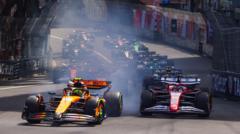
McLaren's Lando Norris won the 2025 Monaco Grand Prix from pole position in a race that featured only four overtakes
>Lewis Hamilton is looking forward to the Monaco Grand Prix this weekend.
>"It's the one track where power is not king," the Ferrari driver says. "It's definitely car performance. Our car could be really strong there."
>But if Hamilton and his team-mate Charles Leclerc are expecting a good weekend around the narrow streets because the effect of their engine's power deficit to Mercedes will be less pronounced, they're not the only drivers approaching the race with anticipation.
>In fact, pretty much every driver is - because the unique nature of Monaco should mean that it is a race different in character to the rest of this season. And perhaps - although this is less likely - even the character of the Monaco Grand Prix itself could change.
>In qualifying, the drivers expect that for the first time this year, they should be able to drive on the limit at all times; the fact that they cannot is their biggest complaint about this year's cars.
>And in the race, there is a thought that overtaking might just about become possible in certain circumstances. Even if, as one senior figure puts it, "in the end, it's Monaco. It won't be about overtaking."
>Let's delve into both to see how Monaco might change things.
>Monaco has become notorious in recent years for soporific races in which the leader controls the pace from the front in an attempt to secure the victory knowing that overtaking is almost impossible.
>Last year's 78-lap race had just four overtakes in total. The average for 2025's 24 grands prix, discounting sprints, was 66.9.
>F1 has taken on a new look this year, with increased levels of overtaking and on-track battles lasting for many laps, with drivers swapping positions repeatedly.
>Could this change the character of the race where overtaking is most difficult?
>On paper, there are reasons to believe it might. A bit, anyway.
>Drivers have complained in recent years that the cars were simply too big - too long and wide - to race effectively in the tight confines of the streets of Monaco.
>But the fact that the cars are slightly lighter and smaller this year is unlikely to make a difference.
>While the 2026 cars are 10cm narrower and slightly shorter, they are still 10cm wider than the cars of 20 years ago. And overtaking has been all but impossible at Monaco between cars of similar levels of competitiveness for at least half a century.
>If anything is going to change the nature of racing in Monaco, it is the new engines, with their nominal 50-50 split between internal combustion and electrical power, and - most importantly - the new overtake mode.
>'Overtake' gives a driver within a second of a car in front an extra 0.5MJ of electrical energy per lap. This is central to the new character of racing this year and the battles that many in the sport, including drivers, have described as "yo-yo racing".
>Cars have ended up tied together for several laps because the car behind passes the one in front with help from the overtake mode. Only for the advantage to then pass to the car that has just been overtaken, when it gets overtake mode.
>It has been proving difficult for drivers to break free of this back-and-forth, and every race this season has had examples of this sort of battle.
>No-one knows how overtake mode will affect racing in Monaco until Sunday afternoon. But if it is to make a difference and enable drivers to at least get into a position to try an overtake, this is likely to be in combination with an offset in tyre degradation.
>If the car in front is struggling with rear tyre wear, and is therefore limited on grip during acceleration, that, combined with overtake mode, just might make them vulnerable to the car behind.
>But the nature of Monaco means that certain aspects of overtake mode will not be in play this weekend.
>The plethora of overtaking manoeuvres this year has often been caused by the two cars involved being in different states of energy deployment.
>The extra energy provided by 'overtake' mode means the car behind can deploy electrical power for longer than the car in front.
>So, when one car has an extra 350kW - 480bhp - compared with the one it's racing, it's going to get past. This is what has led two-time champion Fernando Alonso to refer to many overtakes this year as "avoiding actions".
>It's a view shared by Max Verstappen, if expressed in a different way.
>This arises because the cars are fundamentally energy starved this year - they simply cannot recover sufficient electrical energy to be able to have full power at all times a driver would want.
>Monaco, though, is the least energy-starved track of the year. So this offset in power will be far less common.
>Qualifying is the area in which the new cars are most compromised, simply because of this energy starvation.
>But in Monaco, unlike many tracks this year, the cars will be energy rich instead. Because of the high number of corners and limited amount of straights, recovering energy is much easier and there is less opportunity to use it.
>That means energy recovery should happen naturally with braking, rather than the various means that have been used to recover while the cars are on the straights, and the drivers should have full power available to them at all times on a qualifying lap for the first time this year.
>McLaren's Oscar Piastri, whose team are celebrating becoming only the second team to compete in 1,000 grands prix this weekend, said: "We'll be at full power everywhere, as far as I'm aware, or very close to it on all straights, which is good."
>Leclerc, who has been on pole at Monaco three times in the past six years, and never lower than third in that period, said: "Monaco is actually going to be one of those races where these cars might be very good. First, we have now lighter cars, which is, I think, a good thing and we can definitely feel that. And for a track like Monaco, I think this has its benefits.
>"And I think the electric side is going to be a lot less big in Monaco, just because we'll be recharging quite a bit with all the corners that there are. So I'm quite excited for Monaco."
>Various changes are being made to the cars' settings by governing body the FIA on safety grounds.
>Straight-line mode - where the front and rear wings open on the straights to increase speed - will be disabled.
>And the electrical side of the engine will only be able to deploy the full 350kW up to 200km/h (124mph) before a ramp-down slope starts to take effect.
>Despite this, McLaren team principal Andrea Stella says: "Monaco, there will be less of the issues that we see in tracks where you are energy starved.
>"It should be more normal, and if anything it will be quite a lot of power to drive a Formula 1 car in the streets of Monaco. So, I think different challenges in terms of having to harness so much power for the tyres, for the car itself and for the drivers.
>Live commentary on BBC Radio 5 Live and BBC Radio 5 Sports Extra 2 and 3; live text updates on BBC Sport website and app
>Will Monaco suit Ferrari more than rivals? F1 Q&A
>Classic Monaco Grand Prix images through the years